
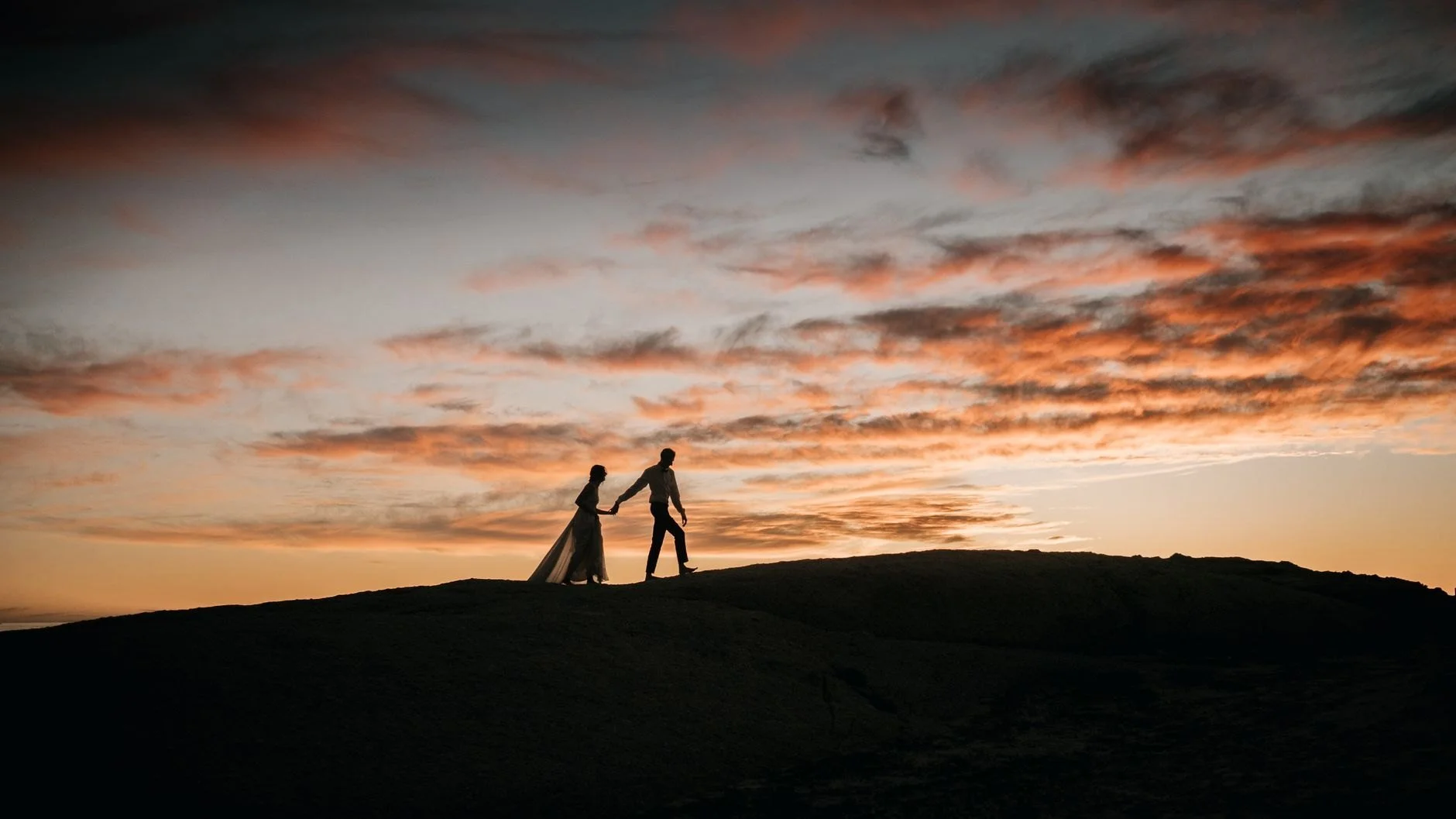
If your wedding falls between November and January, this one surprises a lot of couples. When the clocks go back in early November, Bay Area sunsets move to about 5 p.m. By early December they're closer to 4:50.
That changes how the whole day fits together. In summer, sunset comes during dinner, and the two of you step out between courses for ten minutes of portraits. In winter, sunset can come before the reception starts. Sometimes it comes before the ceremony is over.
Here's the good part. Winter light is lovely. The sun stays low all day, so the light is softer and warmer than it is at noon in July. You just have to plan to be outside while it lasts.
What happens when the timeline doesn't account for it
Picture a 4 p.m. ceremony in early December. The two of you walk back up the aisle around 4:30. Then come the hugs, the congratulations, the family photos. By the time you're free, it's dark.
Nothing is ruined. The reception will still look warm and beautiful under string lights and candles. But the golden light you pictured in your film, the two of you walking together as the sky changes color, happened while you were hugging your aunt.
Couples often tell us this was the part they didn't see coming. They toured the venue on a September evening, saw how the light looked at 6:30, and expected the same on their wedding day.
Start with your sunset time
Before you plan anything else, look up the exact sunset time for your date. A quick search for "sunset" plus your date and city is enough. Then count backward.
The best light for portraits is usually the 45 minutes to an hour before sunset. In winter that window goes by quickly. After the sun drops you get maybe 15 to 20 minutes of soft blue light, and then it's night.
Put that window at the top of your timeline. Plan the rest of the day around it.
Late October weddings have a little more room, with sunset still after 6. Once the clocks change, though, you'll want to plan carefully for the light.
Option one: a first look
This is the easiest fix, and it's what we suggest most often for winter weddings.
A first look means the two of you see each other privately before the ceremony. That moves your portraits, wedding party photos and most family photos into the early afternoon, while the light is still good. After the ceremony you can go straight to your guests, or slip away for a few minutes at sunset.
On film, a first look is often one of the quietest moments of the day. Just the two of you, a few feet apart, no crowd watching. You'll hear what you say to each other, and it's usually something nobody else would have heard.
Some couples really want to see each other for the first time at the aisle. That's completely fair. If that matters to you, the next two options still work.
Option two: an earlier ceremony
If you want to keep that aisle moment, start the ceremony early enough that you finish well before sunset. For a December wedding with a 4:50 sunset, a ceremony at 2:30 or 3 p.m. leaves time for family photos and a short portrait session while the light lasts.
It might feel early on paper. Guests rarely mind, and it gives everyone a longer evening. A longer cocktail hour also gives the film more of the small moments: grandparents catching up, a cousin meeting the new baby, your college friends together in one place again.
Ask your venue early what start times are possible. Some have set windows, and it helps to know before invitations go out.
Option three: a short sunset walk
Even if everything else happens early, save ten or fifteen minutes around sunset for just the two of you.
It doesn't need to be a full portrait session. Just a short walk away from the crowd while the sky changes. We'll follow at a distance, and you'll barely notice we're there. These shots often end up near the end of a film, because they feel like a breath after a full day.
Ask your coordinator or a trusted friend to come get you at a set time so you aren't watching the clock. Write it on the timeline the same way you'd write the cake cutting.
A sample winter timeline
Here's what a first look day could look like in early December, with sunset around 4:50.
12:00 p.m. Getting ready and details
1:00 p.m. First look
1:15 p.m. Couple portraits, then wedding party
2:15 p.m. Family photos, then the two of you tuck away before guests arrive
3:00 p.m. Ceremony
3:30 p.m. Cocktail hour
4:20 p.m. Sunset walk, about 15 minutes
5:15 p.m. Grand entrance and dinner
Without a first look, you might start the ceremony at 2:30, do family photos from 3:00 to 3:30, then couple and wedding party portraits until about 4:30, finishing with a few minutes alone at last light.
Every day is different, so use this as a starting point, not a rule.
Getting ready light counts too
With an early ceremony, getting ready happens in late morning and early afternoon. That's actually a nice time for it. If you can, choose a room with a big window and ask everyone to switch off the overhead lights. Soft window light on a dress or a jacket being buttoned looks lovely on film, and it's free.
Let the evening be the evening
Once the sun is down, the film changes mood, and that's a good thing. Candles on the tables, string lights, a full dance floor. Toasts by candlelight are some of the warmest footage of the night.
You don't have to fight the early sunset. You just want the golden light to show up in your film, not after it ends.
If you're planning a fall or winter wedding in Napa or anywhere around the Bay Area, tell us your date and a little about your day. We'll look up your sunset time with you and help shape a timeline that puts the light where you want it.
Want to see how winter light looks in a wedding film? See our work 👉 https://www.featherstonefilms.com/examples